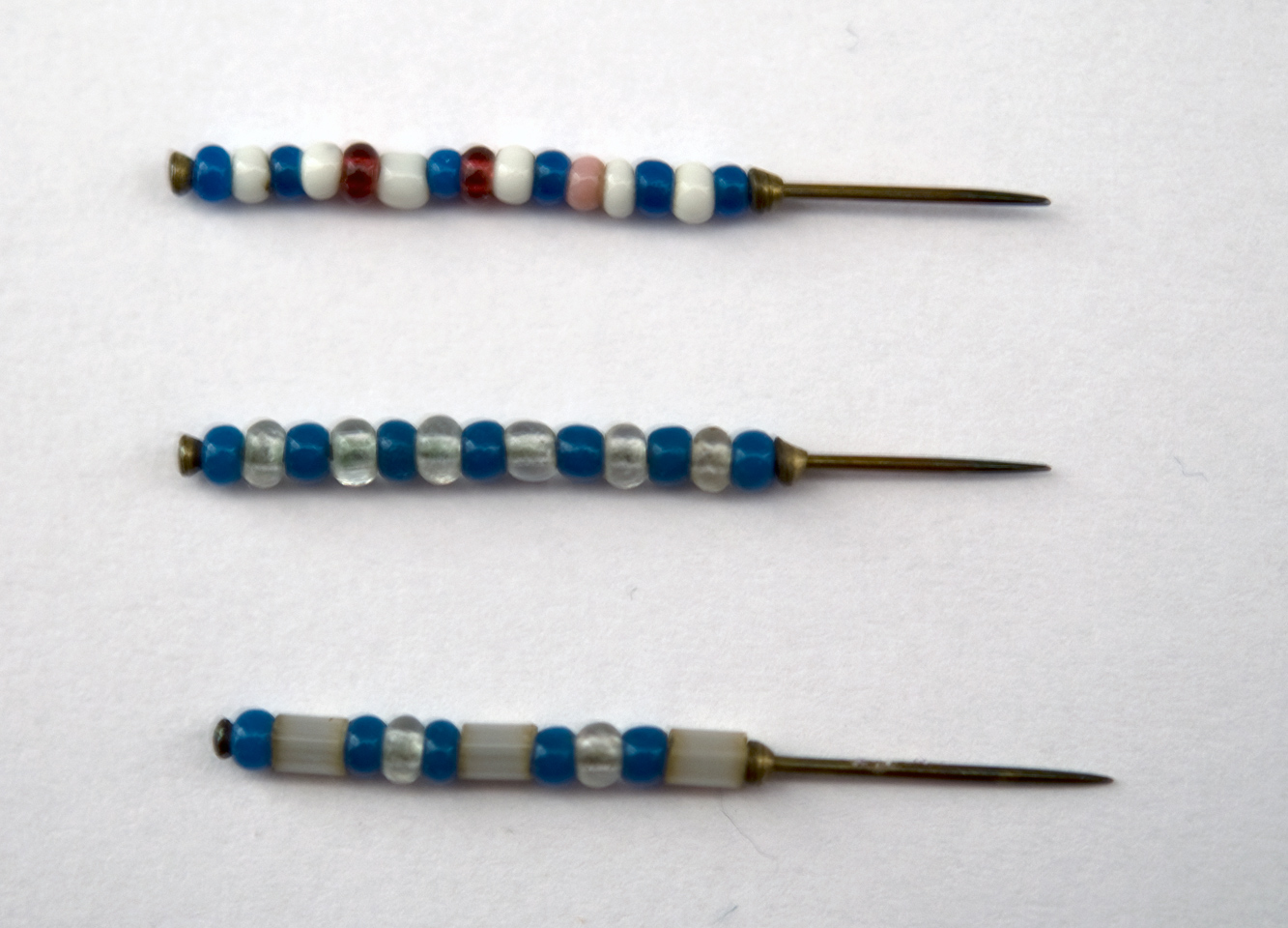
Marker Pins
Modern lacemakers uniformly refer to these pins as 'strivers', reflecting the fact that they were used to mark the beginning of the day's work. This is a progress indicator, showing how much the lacemaker 'strove' during the day. I have heard several lacemakers tell me that their teachers presented them with gifts of the older beaded pins.
But the Etymology of these pins is more complex, as indicated by this quote from Thomas Wright:
The workers liked to use pins with red waxed or beaded heads for the Headside (or Turnside) of the lace, and gold wax or green beaded pins for the Footside. Sometimes, however, for these purposes they used pins on which were threaded six or more tiny beads of blue and white or red and white placed alternately. In North Bucks these pins are called Limicks, in South Bucks, Bugles, in Beds, King Pins, and like the other coloured pins they added greatly to the beauty of the pillow. In making limicks, after the beads had been threaded on a pin, the head of another pin (often removed, I am sorry to say, but the teeth) was threaded to prevent the beads from dropping off, so for every limick that was made one pin was wasted. As the heads of modern pins are not removable, limicks cannot now be made.
Thomas Wright
The Romance of the Lace Pillow, 1919
In my examples the extra pinhead holding the beads in place can clearly be seen. The tradition of passing 'striver' pins to students must be an old one - the handmade pin, of which these are examples, was abandoned around 1800 (trying to pin down a better date). The famous quote from Adam Smith describing the making of pins is worth repeating here:
To take an example, therefore, from a very trifling manufacture; but one in which the division of labour has been very often taken notice of, the trade of the pin-maker; a workman not educated to this business (which the division of labour has rendered a distinct trade), nor acquainted with the use of the machinery employed in it (to the invention of which the same division of labour has probably given occasion), could scarce, perhaps, with his utmost industry, make one pin in a day, and certainly could not make twenty. But in the way in which this business is now carried on, not only the whole work is a peculiar trade, but it is divided into a number of branches, of which the greater part are likewise peculiar trades. One man draws out the wire, another straights it, a third cuts it, a fourth points it, a fifth grinds it at the top for receiving, the head; to make the head requires two or three distinct operations; to put it on is a peculiar business, to whiten the pins is another; it is even a trade by itself to put them into the paper; and the important business of making a pin is, in this manner, divided into about eighteen distinct operations, which, in some manufactories, are all performed by distinct hands, though in others the same man will sometimes perform two or three of them. I have seen a small manufactory of this kind where ten men only were employed, and where some of them consequently performed two or three distinct operations. But though they were very poor, and therefore but indifferently accommodated with the necessary machinery, they could, when they exerted themselves, make among them about twelve pounds of pins in a day. There are in a pound upwards of four thousand pins of a middling size. Those ten persons, therefore, could make among them upwards of forty-eight thousand pins in a day. Each person, therefore, making a tenth part of forty-eight thousand pins, might be considered as making four thousand eight hundred pins in a day. But if they had all wrought separately and independently, and without any of them having been educated to this peculiar business, they certainly could not each of them have made twenty, perhaps not one pin in a day; that is, certainly, not the two hundred and fortieth, perhaps not the four thousand eight hundredth part of what they are at present capable of performing, in consequence of a proper division and combination of their different operations.
Adam Smith
An Inquiry Into The Nature And Causes Of The Wealth Of Nations, 1776
first posted 9/12/2009 |